If you got into UCLA but not as a CS major — and you want to study computer science — this post is for you.
I entered UCLA in Fall 2025 as an Econ major in the College of Letters & Science. One year later, I’ve completed all the prep courses required to transfer into CS. This post breaks down UCLA’s five CS-related majors, the transfer requirements, and the mistakes I made during NSO (New Student Orientation) so you don’t have to.
UCLA’s Five CS-Related Majors
| Major | School | Focus |
|---|---|---|
| Computer Science | Samueli (Engineering) | The standard CS track: OS, networking, compilers in upper-division |
| Computer Engineering | Samueli (Engineering) | Hardware-heavy, significant ECE overlap |
| Computer Science & Engineering | Samueli (Engineering) | Hybrid of CS and CE |
| Math of Computation | Letters & Science | Same lower-division as CS, upper-division leans toward theory of computation |
| Linguistics & CS | Letters & Science | Interdisciplinary, NLP-oriented |
Important rule for L&S students wanting to double-major in Engineering: you must transfer into the Engineering school and declare the Engineering major first, then apply for an L&S double major. You cannot declare an L&S major first and “add” an Engineering one on top. This means transferring into Engineering has to be step one.
CS Transfer Requirements
UCLA’s transfer process is relatively lenient compared to peer institutions. Here are the conditions for students entering Fall 2025 or later:
1. Engineering Workload
A quarter counts as an engineering workload if it includes:
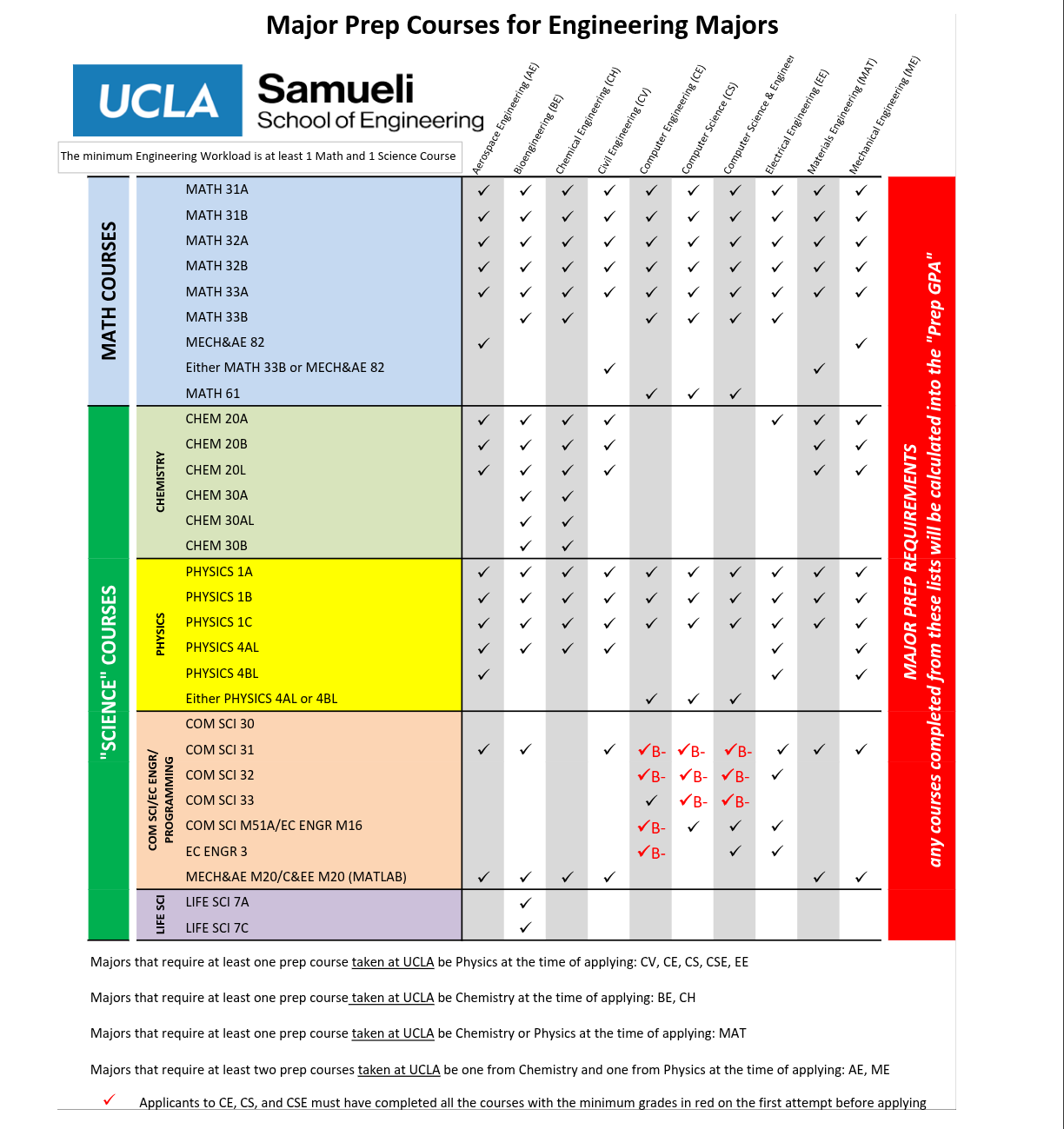
- One “math” course from the prep course list
- One “science” course from the prep course list
- At least 12 units total
- At least 8 units from the prep course list
First-year applicants need at least 2 engineering workloads. Second-year applicants need at least 3.
2. GPA Requirement
- Students entering Fall 2025 or later: prep course GPA ≥ 3.700
- Students entering before Fall 2025: ≥ 3.500
3. Required Courses
- COM SCI 31: minimum B-
- COM SCI 32: minimum B-
- COM SCI 33: minimum B-
- At least one Physics 1-series course completed
Full official guide: UCLA Engineering Change of Major
Math of Computation: The Hidden Shortcut
If you were admitted to Letters & Science (like I was, into Econ), there’s a major that feels almost designed for CS hopefuls: Math of Computation.
How it compares to CS:
- Identical lower-division courses (CS 31/32/33, Math 31-33 series)
- Same priority enrollment for CS courses
- Upper-division leans toward theory of computation rather than systems engineering
Here’s the key advantage: intra-college transfers are trivially easy. During NSO, I filled out a Google Form with 3–4 questions and switched from Econ to Math of Computation on the spot. No waiting a quarter or two, no GPA threshold to hit.
If your end goal is Engineering CS, declaring Math of Computation first gives you CS-level course enrollment priority during your lower-division years. This prevents the nightmare scenario of being locked out of CS 31/32 while you’re still working on your Engineering transfer application.
NSO Course Enrollment Strategy
UCLA’s NSO enrollment works differently from the normal first-pass/second-pass system: courses are released in batches across orientation sessions, and everyone in your batch enrolls at the same time.
My recommended order:
- Cluster courses if you want one (efficient way to knock out GEs, but locks you in for the full year)
- Major courses first — CS 31/32 don’t have priority windows for non-CS majors during NSO
- GEs last
If you’ve already switched to Math of Computation, you’ll have priority enrollment for CS 31/32. That alone is the biggest practical benefit of making the switch.
Lessons
- Research transfer policies early. The difficulty gap between intra-college and cross-college transfers at UCLA is enormous. Intra-L&S transfers are nearly frictionless; cross-college transfers require planning and some luck.
- Math of Computation is a low-risk stepping stone. If you’re not sure you can pull off the Engineering CS transfer, lock in Math of Computation first. You lose nothing and gain enrollment priority.
- NSO lectures are skippable. Nearly everything is a rehash of public info on department websites. If you want to build relationships with professors, go to office hours after week 3 — it’s far more effective than elbowing through the post-lecture crowd during NSO.
Next post: what I actually took and learned during my first quarter on the CS track.